


A semi-solid-state power bank uses a battery that contains less liquid electrolyte than a conventional lithium-ion battery. That change makes the battery more stable, helps it manage heat better, and lowers the risk of overheating. The result is safer, more reliable portable power.
Most people choose a power bank by capacity, size, and price. Those details matter, but the battery inside matters just as much. It affects how warm the power bank gets, how well it holds up over time, and how it behaves if something goes wrong.
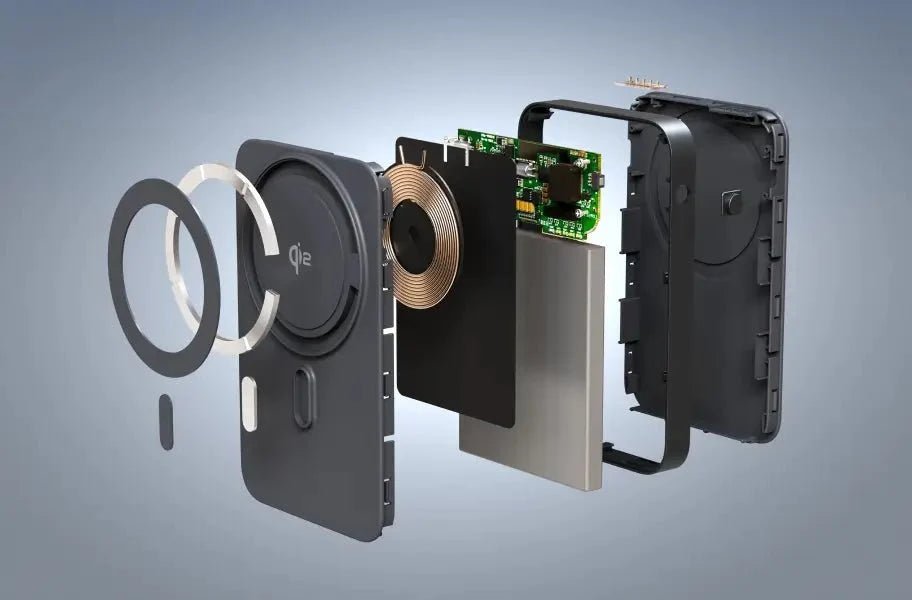
This guide explains semi-solid-state battery technology in plain terms and uses the HyperJuice 5K Qi2 Semi-Solid-State Power Bank as a real-world example.
What Is Semi-Solid-State Battery Technology?
Semi-solid-state battery technology uses an electrolyte that is part liquid and part solid or gel, instead of the fully liquid electrolyte found in conventional lithium-ion batteries.
Every rechargeable lithium battery has three core parts: a positive electrode, a negative electrode, and an electrolyte. The electrolyte moves lithium ions between the electrodes as the battery charges and discharges. In a standard lithium-ion battery, that electrolyte is a flammable liquid.
A semi-solid-state battery reduces the amount of that liquid. It sits between two categories:
- Conventional lithium-ion: fully liquid electrolyte, widely used, but more sensitive to heat and damage
- Semi-solid-state: reduced liquid electrolyte, with improved stability and heat resistance
- Fully solid-state: no liquid electrolyte, still largely in development for consumer products
Semi-solid-state technology brings many of the stability benefits of solid-state designs into products you can buy and use today.
How Does Battery Technology Relate to Power Bank Safety and Reliability?
The battery chemistry inside a power bank directly affects how it handles heat, stress, and physical damage, which are the main factors behind power bank safety and reliability.
Most battery problems start with heat. When a conventional lithium-ion cell gets too hot, the liquid electrolyte can break down. In rare cases, this can lead to swelling, leaks, or a chain reaction called thermal runaway.
Less liquid electrolyte means less material that can react to excess heat. The semi-solid-state battery in the HyperJuice 5K Qi2 Semi-Solid-State Power Bank offers improved heat stability and is designed to stay more stable if punctured or physically damaged.
Reliability follows the same logic. A battery that runs cooler and stays stable tends to deliver more consistent performance from day to day. For a power bank that rides in your pocket or bag, gets dropped, and charges your phone daily, that stability counts.
Why Is Hyper Using Semi-Solid-State Technology in a Compact Everyday Power Bank?
Hyper uses semi-solid-state technology because compact power banks are carried close to the body, charged often, and used in tight spaces where heat builds up quickly.
A small power bank lives a demanding life. It sits in pockets, backpacks, and car cup holders. Bringing semi-solid-state technology into a pocket-sized design addresses those everyday conditions directly.
The 5,000mAh (18Wh) capacity is sized for daily top-ups rather than multi-day trips. That keeps the device light and portable. It also keeps it under airline battery limits, so you can pack it in your carry-on.
How Can Improved Thermal Management Support Charging Performance?
Better thermal management keeps the power bank cooler during use, which allows it to maintain efficient charging instead of slowing down to protect itself from heat.
Wireless charging produces more heat than wired charging, so it's especially prone to throttling. The HyperJuice 5K Qi2 Semi-Solid-State Power Bank offers advanced thermal stability that helps keep temperatures down during wireless charging. That brings two practical benefits:
- More consistent charging speeds, because the system is less likely to throttle
- Less heat stress on your phone, which sits directly on the power bank during wireless charging
How Can Reduced Heat Degradation Support a Longer Battery Lifespan?
Heat is one of the main causes of battery aging, so reducing heat-related degradation helps a battery hold its capacity for longer.
All rechargeable batteries lose capacity over time. Each charge cycle causes small chemical changes inside the cell. Heat speeds up those changes. A battery that regularly runs hot will lose usable capacity faster than one that stays cool.
Because the HyperJuice 5K Qi2 Semi-Solid-State Power Bank uses less liquid electrolyte and manages heat more effectively, it helps reduce heat-related degradation. Hyper designed it for longer-lasting battery performance.
You can support battery health further with a few simple habits:
- Avoid leaving the power bank in hot cars or direct sunlight
- Remove thick phone cases if they trap heat during wireless charging
- Store it partially charged if you won't use it for a while
How Does the Technology Work Alongside Qi2 Magnetic Charging?
Semi-solid-state technology and Qi2 work together: Qi2 delivers efficient, magnetically aligned wireless power, while the battery's thermal stability helps keep that process cool and consistent.
Qi2 uses built-in magnets to lock the charger into the correct position on your phone. Good alignment matters because misaligned coils waste energy as heat.
The HyperJuice 5K Qi2 Semi-Solid-State Power Bank delivers up to 15W of Qi2-certified magnetic wireless charging. Here's how the two technologies complement each other:
- Qi2 magnets keep the coils aligned, which improves efficiency and reduces wasted heat
- The semi-solid-state battery manages the heat that remains, so charging stays steady
- Together, they support faster, more efficient charging that's easier on your phone
The HyperJuice 5K Qi2 Semi-Solid-State Power Bank works with Qi2 and MagSafe-compatible iPhones, as well as Qi-enabled Android devices.
Why Does Hyper Carry Out 115+ Independent Safety Tests?
Hyper carries out 115+ independent safety tests to verify that the HyperJuice 5K Qi2 Semi-Solid-State Power Bank performs safely and consistently across real-world conditions, not just in ideal lab settings.
Safety testing for power banks typically covers areas such as electrical performance, temperature behavior, charging under different loads, and physical stress. Running more than 115 tests reflects a focus on consistent, safe operation across the many ways people actually use a power bank.
A New Standard for Portable Power
A semi-solid-state power bank replaces some of the liquid electrolyte found in standard lithium-ion batteries. That simple change improves stability, keeps temperatures lower, and helps reduce heat-related battery wear.
The HyperJuice 5K Qi2 Semi-Solid-State Power Bank brings that technology into a pocket-sized, airline-friendly design. It pairs 5,000mAh of capacity with 15W Qi2 magnetic charging and 20W USB-C. It's backed by four built-in circuit protections, UL-compliant fire-retardant materials, and 115+ independent safety tests.
If you're choosing a power bank for daily carry, look beyond capacity and check the battery technology inside. You can find full specs and compatibility details here.

iPhone 18 Pro Charging Guide: The Best Chargers, Cables and Power Banks
Share: