

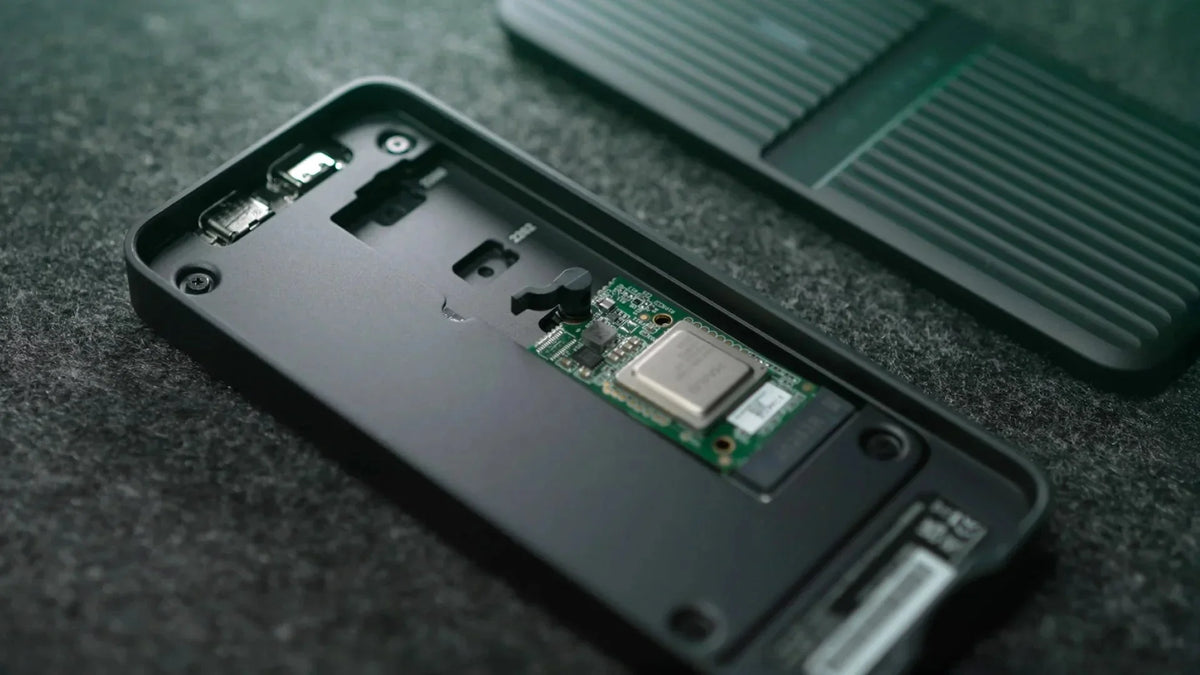
External connectivity has traditionally focused on storage and peripherals. Compute expansion remained internal due to bandwidth and latency limits. USB4 changes that by making PCIe expansion over USB practical for real workloads.
With USB4 V2 delivering up to 80Gbps of bandwidth, external enclosures can now support both high-speed NVMe storage and compact PCIe expansion modules such as AI accelerators.
Why PCIe Expansion Was Limited to Internal Systems
PCIe devices require consistent, low-latency data transfer. Internal slots provide dedicated lanes and predictable performance, which is why accelerators and specialized cards have remained inside desktops.
Earlier external interfaces lacked the bandwidth and efficiency to support PCIe devices without severe tradeoffs. USB4 addresses this by tunneling PCIe more efficiently and providing higher sustained throughput.
What USB4 Enables for External PCIe Devices
USB4 supports native PCIe tunneling over USB-C. USB4 V2 doubles available bandwidth and improves how PCIe traffic is transported, reducing overhead and contention.
This allows external PCIe hardware to operate more reliably under sustained workloads, especially for compact devices that do not require full desktop power or cooling.
M.2 PCIe Expansion Beyond Storage
The M.2 form factor is not limited to NVMe SSDs. It also supports PCIe devices such as AI accelerators, networking adapters, and specialized compute modules.
Short M.2 cards are designed to add targeted capability rather than replace a GPU. When paired with a USB4 enclosure, these modules can be used externally without modifying the host system.
AI Workflows That Benefit From External PCIe
External PCIe expansion over USB4 is well suited for local inference, testing, and edge workflows. Developers can run models locally without relying on cloud services. Engineers can offload specific tasks from the CPU. Creators can accelerate AI-assisted tools while keeping their existing setup.
USB4 V2 provides the bandwidth needed for these modules to operate without being constrained by the interface.
Expanding Capability Without Replacing Hardware
External PCIe expansion allows users to add functionality without opening a system or switching to a desktop form factor. This is especially valuable for laptops and compact workstations with limited internal expansion.
Modules can be swapped or upgraded as needs change, making system capability more flexible over time.
USB4 Turns External Connectivity Into a Platform
USB4 moves external connectivity beyond peripherals. It becomes a way to extend system capability through modular PCIe hardware.
With sufficient bandwidth and proper support, external PCIe expansion is no longer experimental. USB4 V2 removes the interface bottleneck and enables practical external compute alongside high-performance storage.


What Is USB4 V2 and Why 80Gbps Matters for External SSDs
USB4 M.2 PCIe Enclosure Guide: How External NVMe Works
Share: